


HOME / Parent portal / I am new here / Lab tests & clinical observation

Lab tests & clinical observation
How data is used and why trends matter
Why laboratory tests are essential:
Dr. Ken never prescribes treatment blindly. Any clinical decision is based on laboratory data combined with careful clinical observation, not on symptoms alone.
Laboratory tests help reveal biological processes that cannot be assessed from behavior or questionnaires — including inflammation, immune imbalance, infections, metabolic stress, and hormonal regulation. Without this information, treatment would be speculative rather than clinically grounded.
Review of existing laboratory tests
01

Most families begin by sending all laboratory tests their child has already completed, even if they were done months or years ago.
Dr. Ken carefully reviews:
All previous laboratory results,
Their clinical relevance,
Patterns that may still be meaningful today.
Based on this review, Dr. Ken determines whether:
Existing tests are sufficient to guide treatment decisions, or
Additional laboratory data is needed
This visit focuses on clinical reasoning and orientation, not on rushing into action.
Why Older Laboratory Tests May Not Be Sufficient
02
Parents often have laboratory tests that are outdated. This is important because biological processes are dynamic:
Based on this review, Dr. Ken determines:
Inflammation levels change
Immune activity shifts
Infections may become reactivated or suppressed
Metabolism and hormonal balance evolve
Supplements, medications, illness, or stress affect results
Older tests provide valuable background, but they may not reflect the child’s current biological state.

When up-to-date data is missing, safe and accurate clinical decisions become difficult.
When Additional Tests Are Recommended
03
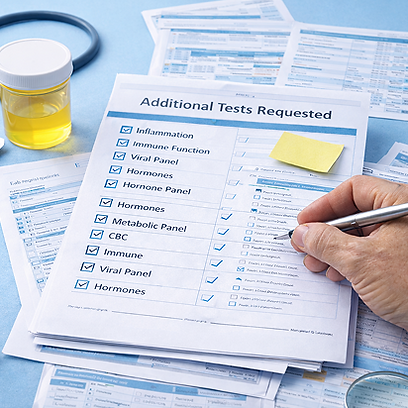
If existing laboratory data is incomplete or outdated, Dr. Ken may recommend additional targeted laboratory tests.
These tests are selected to answer specific clinical questions, such as:
Is inflammation still active?
How is the immune system functioning now?
Are chronic or latent infections contributing to symptoms?
Are metabolic or hormonal factors affecting the child’s condition?
Testing is always selective and clinically justified, never automatic.
Comprehensive Laboratory Evaluation — Only When Needed
04
If laboratory data is very limited or absent, or if the child’s condition is complex, Dr. Ken may recommend a comprehensive laboratory evaluation covering all key biological categories.
Important to know: Dr. Ken usually prescribes a full set of laboratory tests only once.
This comprehensive assessment allows him to:

Anderstand the child’s biological profile in depth
Determine treatment priorities
Avoid repeated or unnecessary testing later
Dr. Ken is fully aware that laboratory tests can be expensive and does not aim to place unnecessary financial burden on families.
How Laboratory Results Are Interpreted
05

Laboratory results are never interpreted in isolation
Dr. Ken evaluates:
Relationships between multiple markers
Patterns across different biological systems
Trends over time
Consistency with clinical observation
The level of inflammation in the child’s body, including inflammatory responses driven by different infections and pathogens
Testing is always selective and clinically justified, nA single abnormal value rarely determines clinical decisions. Understanding comes from the overall picture.ever automatic.
Why Older Laboratory Tests May Not Be Sufficient
06
You Are Not Expected To Have All Tests Completed In Advance
Older Tests Are Useful, But May Need Updating
Not Every Child Needs Every Test
Comprehensive Testing Is Usually Done Once, Not Repeatedly
The goal is always the same:
To understand the child’s biology clearly before making treatment decisions.


Laboratory Testing in Your Country
Families come to us from many different countries.
To make testing easier, we have created a dedicated page with trusted laboratories around the world that can perform commonly used medical tests.
Here you will find:
Laboratories grouped by country
Types of tests available
Practical information to help you plan testing locally
Frequently asked questions
Dear parents,
We are constantly working to make this page as helpful, clear, and practical as possible.
If you feel that some important information is missing, something should be explained in more detail, or there are topics you would like us to cover here — we would really appreciate your feedback.
Your input helps us understand what parents truly need and allows us to continuously improve the content of this page.