


HOME / Parent portal / I am new here / what parents need to know

WHAT PARENTS NEED TO KNOW
From first consultation to next steps
Families often arrive with many questions, mixed emotions, and prior experiences that were confusing or disappointing. This page explains how the process usually begins, what the first consultation is for, how to prepare, and what typically happens next. There is no obligation at any stage.
What Parents Need to Know Before the Initial Consultation
01

Before meeting with Dr. Ken, it is important for parents to understand how our approach works and what makes it different.
We are different from standard autism care
Our approach focuses on medical and biological factors, not behavior alone
All our methods are based on current scientific knowledge
A detailed explanation is provided in the slides below
How Autism Is Commonly Defined (NIH View)
02
According to the NIH and major medical organizations:
Autism Spectrum Disorder is a neurodevelopmental condition
Main features include:
Social communication differences
Repetitive behaviors
Sensory sensitivities
Causes are considered multifactorial
The primary focus is on genetics and development
Recommended interventions are mainly behavioral and educational
What The NIH Model Does Not Fully Address
03
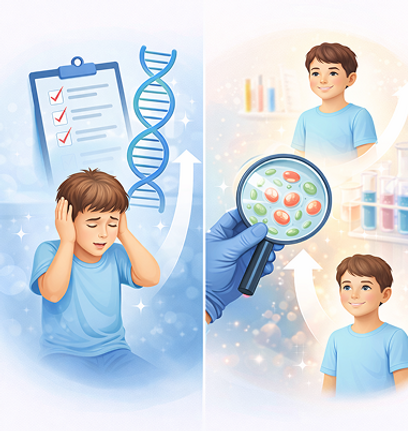
The mainstream autism model focuses primarily on behavior and genetics, while giving limited attention to biological processes that can actively change symptoms over time.
The mainstream model has a limited focus on:
Chronic inflammation
Immune system dysfunction
Persistent or latent infections
Biological mechanisms behind symptoms
Why do symptoms change over time?
Our Medical View of Autism
04
We view autism as a medical-biological condition, not a behavioral one.
Autism affects multiple systems in the body
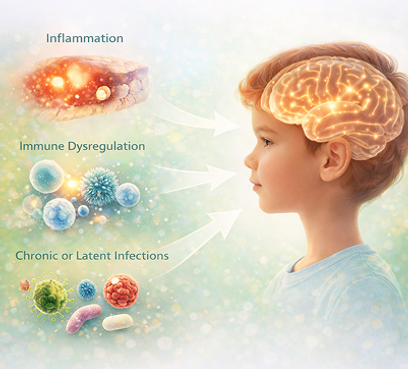
Core drivers often include:
Inflammation
Immune dysregulation
Chronic or latent infections
These processes influence brain function and development
Motor and Sensory Dysregulation
05
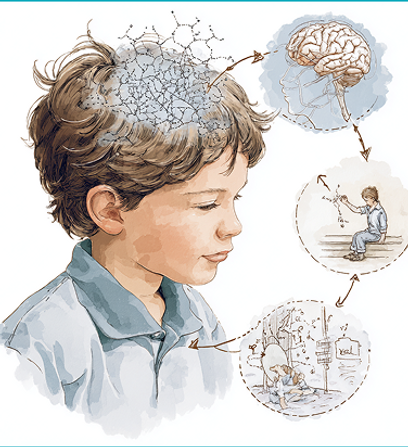
Motor and sensory dysregulation is an early core feature of autism, showing how the brain has difficulty processing and regulating sensory and motor signals.
Autism affects multiple systems in the body
Abnormal sensory processing
Impaired motor coordination
Difficulty integrating sensory input
Overload of the nervous system
Reduced ability to regulate responses
Why Behavioral Symptoms Appear
06
Behavioral and mental symptoms often develop because:
The nervous system is under constant biological stress
The brain struggles to process signals correctly
Motor and sensory dysregulation affects:
Attention
Emotions
Communication
Behavior reflects internal neurological difficulty

Role of Inflammation and the Immune System
07
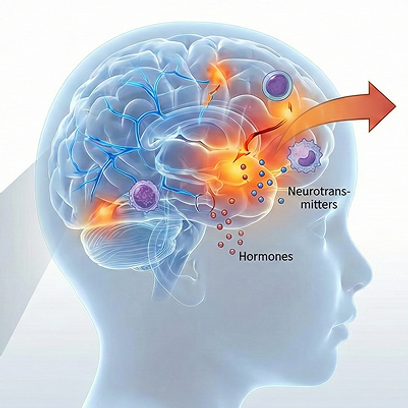
Inflammation and immune imbalance can begin early in life and disrupt brain signaling, neurotransmitters, and hormones
Inflammation may begin:
Before birth
Early in childhood
Immune imbalance affects:
Brain signaling
Neurotransmitters
Hormonal regulation
Ongoing inflammation interferes with normal brain function
Persistent and Latent Infections
08
The body does not fully clear some infections
They may remain:
Latent
Low-grade
Periodically reactivating
These infections can:
Maintain inflammation
Disrupt immune balance
Affects brain and gut function

Why We Do Not Use ABA as Primary Treatment
09
ABA focuses on changing behavior
It does not address:
Inflammation
Immune dysfunction
Neurological dysregulation
In our model, behavior is a result, not the cause
Medical stabilization comes first
What the Initial Consultation Is About
10
This is a medical and biological evaluation
Focus is on:
Medical history
Existing laboratory data
Biological patterns
Goal:
Understand mechanisms
Define priorities
Plan further steps

What the Initial Consultation Is About
11

This is a medical and biological evaluation
Focus is on:
Medical history
Existing aboratory data
Biological patterns
Goal:
Understand mechanisms
Define priorities
Plan further steps
Ongoing inflammation interferes with normal brain function