THE DYSREGULATED BRAIN IN AUTISM

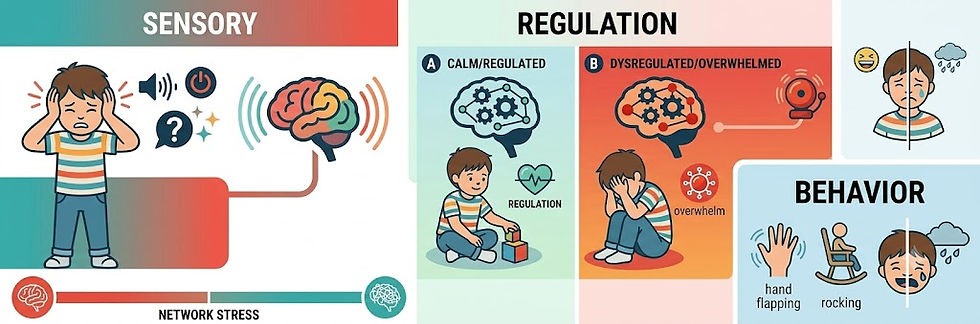
What Parents See and What Is Happening Inside the Autistic Brain

A child covers his ears when a vacuum cleaner starts.
Another cannot sit still for more than a few seconds.
One child spends hours spinning objects, while another becomes overwhelmed by anxiety when entering a grocery store. Some children suddenly laugh for no apparent reason. Others cry inconsolably, become aggressive, or appear trapped in repetitive movements and rituals.
To parents, these behaviors often seem disconnected. To physicians, they may be classified under different diagnostic labels—sensory processing disorder, ADHD, anxiety, emotional dysregulation, obsessive behaviors, or autism itself.
But what if many of these symptoms arise from the same underlying problem?
What if they represent different expressions of a brain struggling to regulate itself?
Modern neuroscience increasingly suggests exactly that.
The autistic brain is not simply a brain that processes social information differently. It is often a brain whose systems for sensation, movement, emotion, attention, and self-control are working under extraordinary stress. The behaviors parents observe are frequently the visible signs of dysfunction occurring deep within neural networks that regulate everyday life.
When the World Feels Too Loud

Many parents describe their child as being "overly sensitive."
The child hears sounds others barely notice. The tag inside a shirt feels unbearable. A crowded room becomes overwhelming.
These reactions are not behavioral choices.
One of the brain structures involved is the thalamus, often called the brain's sensory gatekeeper. Under normal circumstances, the thalamus filters incoming information before it reaches conscious awareness. Most people are constantly exposed to thousands of sounds, sights, and tactile sensations, yet their brains automatically discard what is unimportant.
In many autistic children, this filtering system appears impaired.
The result is a sensory flood.
A refrigerator hum, fluorescent lights, background conversations, and the feeling of clothing against the skin may all arrive at the brain with equal intensity.
Imagine trying to concentrate while every sound in the room is amplified and every sensation demands attention.
For many autistic children, this is daily life.
The Child Who Cannot Stop Moving

Parents frequently ask:
"Why can't my child sit still?"
"Why is he constantly jumping, running, spinning, or pacing?"
The answer often involves brain systems responsible for motor regulation.
One of the most important structures is the cerebellum.
Traditionally viewed as a center for balance and coordination, the cerebellum is now known to influence attention, language, emotional control, and learning.
Postmortem studies have repeatedly shown abnormalities in the cerebellum of autistic individuals, particularly involving specialized neurons called Purkinje cells.
When cerebellar networks function poorly, movement may become poorly regulated.
The child may appear restless, impulsive, clumsy, or constantly in motion.
What parents often interpret as excess energy may actually reflect the brain's difficulty controlling movement and maintaining internal stability.
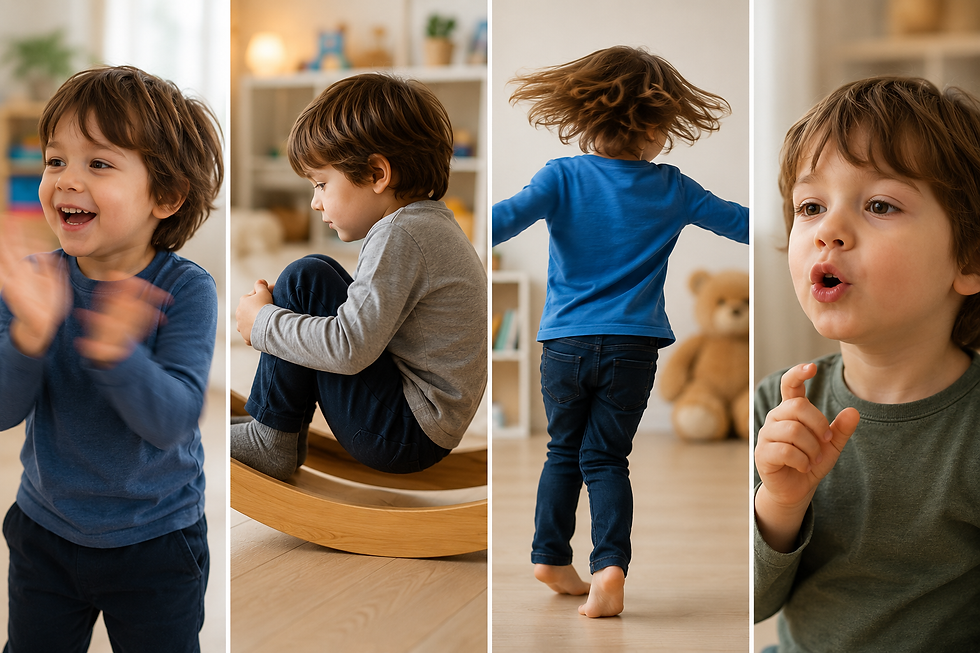
Why Stimming Happens?
Hand flapping.
Rocking.
Spinning.
Repeating sounds or phrases.
Many people view these behaviors as meaningless symptoms.
However, from a neuroscience perspective, stimming may represent the brain's attempt to regulate itself.
Several brain regions contribute to repetitive behaviors, particularly the basal ganglia.
These structures help regulate movement patterns, habits, routines, and repetitive motor programs.
When their activity becomes dysregulated, repetitive behaviors may emerge.
But there is another possibility.
Many autistic children appear to use repetitive movements to manage overwhelming sensory input.
The child who rocks may be calming an overactive nervous system.
The child who flaps may be creating predictable sensory feedback in an unpredictable world.
The behavior may not be the problem.
It may be the child's solution.
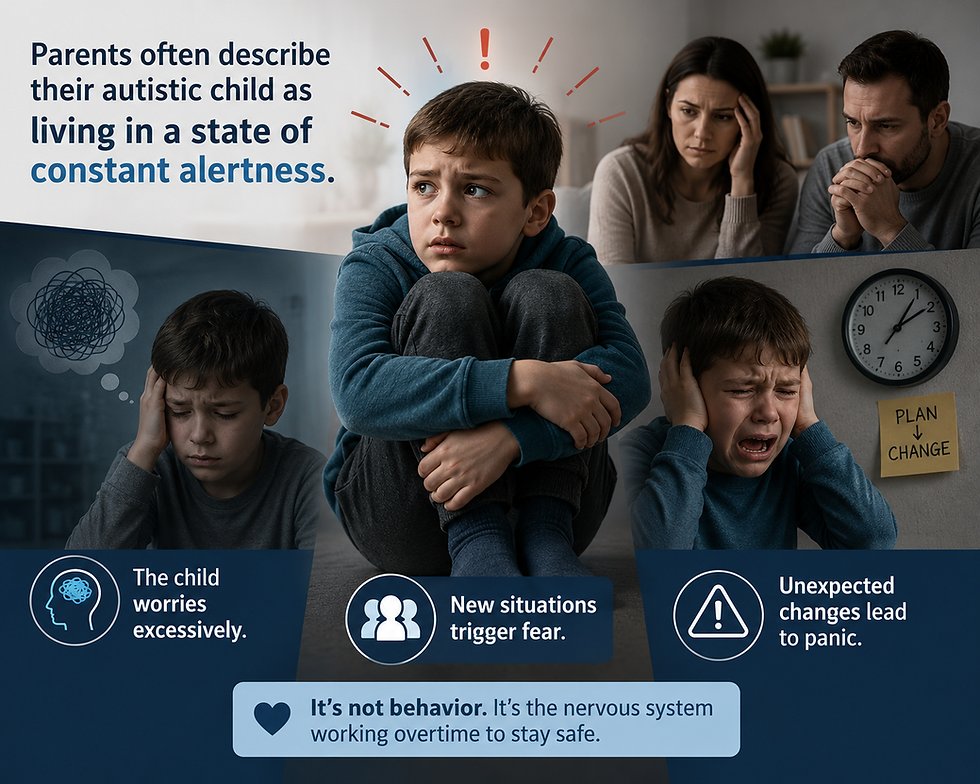
The Anxious Brain
Parents often describe their autistic child as living in a state of constant alertness.
The child worries excessively.
New situations trigger fear.
Unexpected changes lead to panic.
Many struggle with separation anxiety or intense social anxiety.
At the center of these reactions lies a small but powerful structure known as the amygdala.
The amygdala functions as the brain's alarm system.
Its job is to detect danger and initiate protective responses.
Research suggests that in many autistic individuals, the amygdala may become overactive.
As a result, situations that appear harmless to others may be interpreted as threatening.

A new classroom.
An unfamiliar person.
A change in routine.
A loud noise.
Each may activate the brain's threat-detection systems.
The child is not choosing to be anxious.
The child's brain is behaving as though danger is present.

Aggression: When the Brain Loses Control
Perhaps no symptom is more distressing for families than aggression.
A child who was calm suddenly hits, bites, throws objects, or hurts himself.
Parents often wonder:
"Why is this happening?"
The answer frequently lies in a collision between overwhelming emotional signals and impaired self-regulation.
Several regions are involved.
The amygdala generates emotional responses.
The anterior cingulate cortex helps regulate frustration.
The orbitofrontal cortex contributes to impulse control and decision-making.
When these systems become dysregulated, emotions may overwhelm the brain's capacity for control.
The result can be explosive behavior.
In many cases, aggression is not a sign of malice.
It is a sign of neurological overload.
The child is experiencing more emotional intensity than his brain can effectively regulate.
The Child Who Laughs or Cries Without Obvious Reason

Some parents report episodes of sudden laughter or crying that seem disconnected from events occurring around the child.
These episodes can be confusing and frightening.
Yet emotional regulation depends upon a complex network involving the amygdala, anterior cingulate cortex, prefrontal cortex, and cerebellum.
When communication among these regions becomes disrupted, emotions may become poorly controlled.
The child may experience exaggerated emotional reactions.
He may laugh longer than expected. Cry more intensely. Or transition rapidly between emotional states.
These behaviors are not necessarily psychological. They may reflect abnormalities in the neural circuits responsible for emotional regulation.
Looking Beyond the Behavior
For decades, autism has been described primarily through behavior.
We observe the symptoms.
We count the behaviors.
We assign diagnostic labels.
But parents are increasingly asking a different question:
"What is causing these behaviors?"
Neuroscience is beginning to provide answers.
Sensory dysregulation points toward abnormalities in sensory processing networks.
Motor dysregulation implicates the cerebellum and basal ganglia.
Anxiety reflects dysfunction within fear-regulation circuits.
Aggression often emerges when emotional-control networks become overwhelmed.
Stimming may represent the brain's attempt to restore balance.
Each symptom tells a story.
Each behavior provides clues about the brain systems involved.
The Brain Is a Network

Perhaps the most important lesson is that no single brain region causes autism.
The autistic brain functions as a network.
Sensory systems influence emotional systems.
Emotional systems influence attention.
Attention influences learning. Learning influences behavior. When inflammation, immune dysfunction, abnormal neurodevelopment, oxidative stress, or other biological factors disrupt these networks, the effects may appear throughout the brain.
The result is what parents see every day:
A child struggling to process the world.
A child is trying to maintain balance in a brain that is often overwhelmed.
And perhaps most importantly, a child whose behaviors are not random.
They are signals.
Signals from the brain are asking us to understand what is happening beneath the surface.
The Dysregulated Brain in Autism:
What Behaviors Tell Us About the Brain
One of the greatest misconceptions about autism is the belief that behaviors arise in isolation. In reality, behaviors are often outward manifestations of disturbances in specific brain networks. While every autistic child is unique, modern neuroimaging, neuropathological studies, and clinical observations consistently point toward several regions that appear particularly vulnerable.
The autistic brain is not simply "different." In many children it is chronically dysregulated by inflammation, altered connectivity, immune activation, oxidative stress, and abnormal neurotransmitter signaling. The result is impaired communication among brain regions responsible for sensory processing, emotional regulation, motor control, attention, and social interaction.



Comments